September 14, 2026
How Was the Pixeldeed Whitelist Built? A Data-Driven, Fair Snapshot
Why most whitelists feel unfair
Follow on X, drop a "gm," collect an invite code - that's how most NFT whitelists work. But what actually happens in the end? The person who ran the most bot accounts, the person who spun up the most alt wallets, wins. The genuine user who got in early, took real risk, and traded actively usually gets left with nothing to show for it.
Pixeldeed approached this problem differently from day one: no Discord community, no social tasks. Instead, the only criteria are real onchain actions, real capital committed, and real hodl duration. Below, we break down exactly how this criteria was calculated, with the full numbers.
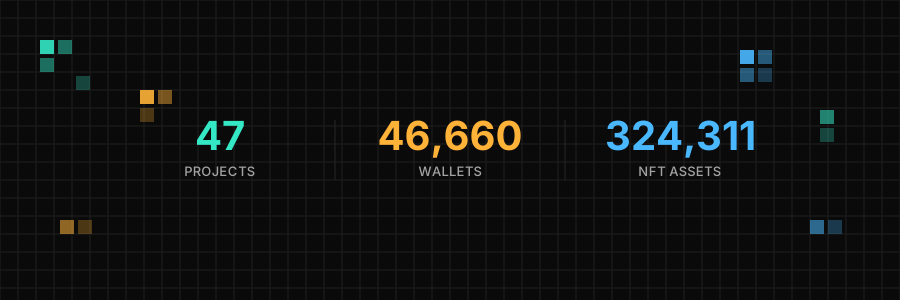
1. The source data: 47 projects, 46,660 wallets, 324,311 nft assets
We selected the 47 NFT projects that traded most actively on Robinhood Chain over the last two months, and ran a full analysis of when each wallet became a holder, how much volume it generated, and how long it held its position - across 46,660 unique wallets.
This isn't "how many invite codes did you collect" - it's a way of measuring how many real ecosystems on Robinhood Chain you've actually, actively participated in, and for how long.
2. Diversity Score: the key metric is how many collections you hold
The core logic is simple: someone who actively participated across many different collections is valued more highly than someone who holds a large amount in just one collection. That's because it's the strongest signal of whether you're a genuine supporter of the ecosystem.
So we calculated each wallet's "Effective Collections" count - the number of collections that effectively count.
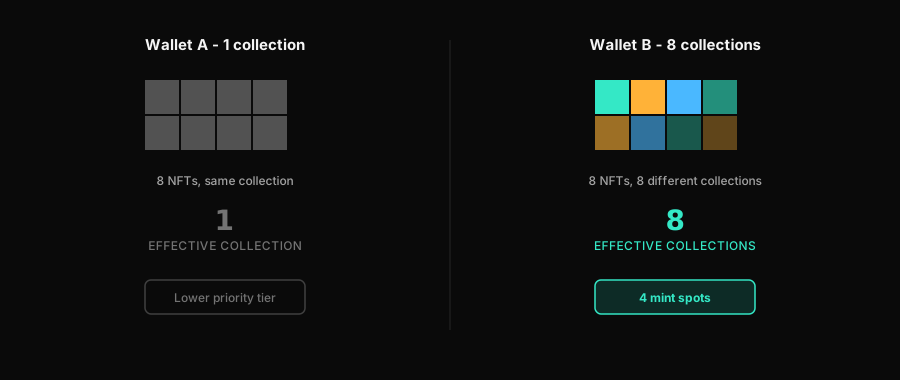
This makes it impossible to artificially inflate your diversity score just by holding those two "cheap" collections.
3. Spot allocation tiers - rewarded in proportion to the risk you took
The higher your Effective Collections count, the more mint eligibility (spots) you're allocated:
| Effective Collections | Spot / Wallet | Wallet Count | Total Spots |
|---|---|---|---|
| ≥10 collections | 6 spots | 155 | 930 |
| 9 collections | 5 spots | 64 | 320 |
| 8 collections | 4 spots | 123 | 492 |
| 7 collections | 3 spots | 156 | 468 |
| 6 collections | 2 spots | 302 | 604 |
| 5 collections | 1 spot | 492 | 492 |
| 4 collections | 1 spot | 891 | 891 |
| 3 collections | 1 spot | 1885 | 1885 |
| <3 collections | Not in Guaranteed WL | - | 0 |
Holders of 3 to 10+ collections - 4,068 wallets in total - qualify for the Guaranteed Whitelist, and depending on their tier, are eligible to mint 1 to 6 Cells.
Here's something interesting: the 155 wallets active across ≥10 collections can each mint up to 6 Cells, while the 1,885 wallets at the 3-collection tier can each mint just 1 Cell. In other words - the deeper and broader your participation, the more the reward scales up exponentially.
4. Per-collection breakdown - how many spots each collection unlocks
Beyond the overall tier structure, here's the full transparency breakdown of how many wallets from each collection qualified for the Guaranteed Whitelist, and how many total spots they generated:
| # | Collection | Total Holders | GTD WL-Eligible Wallets | Total Mint Capacity |
|---|---|---|---|---|
| 1 | Quotrons | 918 | 206 | 374 |
| 2 | StonkBrokers | 639 | 310 | 569 |
| 3 | Chain Mancers | 907 | 480 | 940 |
| 4 | RH MACHINES | 2490 | 730 | 1436 |
| 5 | CASHCAT | 3180 | 636 | 1222 |
| 6 | Rekt Tradooors | 2272 | 522 | 1013 |
| 7 | Stackers | 784 | 329 | 722 |
| 8 | Goat Street | 2545 | 863 | 1696 |
| 9 | Spritehood Wisps | 3346 | 438 | 878 |
| 10 | pyopyopyopyo | 1675 | 438 | 932 |
| 11 | PitBoys | 745 | 351 | 842 |
| 12 | OnChainHoodies | 2564 | 703 | 1459 |
| 13 | CACHE FLOW | 1162 | 508 | 1052 |
| 14 | WIF Outlaws | 1026 | 393 | 792 |
| 15 | Zaibatsu Wagies | 323 | 156 | 406 |
| 16 | Coattail Brokers | 503 | 207 | 523 |
| 17 | Button Presser | 6713 | 562 | 1148 |
| 18 | BULLS RUNNERS | 2522 | 206 | 476 |
| 19 | Gremlin Cartel | 1550 | 464 | 1014 |
| 20 | The Oil Rigs | 1779 | 649 | 1253 |
| 21 | Script Kiddies | 2425 | 571 | 1132 |
| 22 | Internet Monkes | 1221 | 451 | 939 |
| 23 | Clay StonKz | 2222 | 686 | 1300 |
| 24 | The Bandits | 2447 | 940 | 1832 |
| 25 | NTRPY | 956 | 275 | 644 |
| 26 | MonkeyHood | 1565 | 483 | 1029 |
| 27 | NetNet Gear | 550 | 146 | 288 |
| 28 | Firm Brokers | 1119 | 325 | 694 |
| 29 | Volt | 2038 | 744 | 1455 |
| 30 | Broker Punks | 568 | 265 | 591 |
| 31 | Robinhood Punks | 2061 | 530 | 1090 |
| 32 | PonsGuy | 2257 | 717 | 1394 |
| 33 | fuwa | 1604 | 491 | 1064 |
| 34 | ROBO BROKERS | 767 | 316 | 747 |
| 35 | TheCardWall | 1686 | 220 | 445 |
| 36 | Hoodie Groupies | 1008 | 359 | 817 |
| 37 | Hoodrats | 557 | 154 | 380 |
| 38 | Merry Men | 725 | 291 | 736 |
| 39 | Robinhood Kitties | 566 | 264 | 574 |
| 40 | Nine To Five | 303 | 92 | 226 |
| 41 | FlockFall Genesis | 651 | 162 | 333 |
| 42 | Suited Ape Society | 812 | 360 | 753 |
| 43 | Wasteland | 967 | 412 | 830 |
| 44 | Yardkeepers | 420 | 189 | 377 |
| 45 | Piggy Banks | 617 | 195 | 400 |
| 46 | The Reserve | 669 | 303 | 663 |
| 47 | Project Mars Plots | 414 | 88 | 163 |
Note: these numbers reflect the overlapping counts of GTD WL-eligible wallets per collection - if one wallet holds several collections, it's counted once within each of those collections. So the sum of this column does not equal the previous section's deduplicated 4,068 unique wallets - the two numbers measure different things.
5. Traders 5555 Holders - extra eligibility based on token holdings
Beyond the diversity analysis, holders of the Traders 5555 collection can qualify for additional guaranteed spots through a separate track:
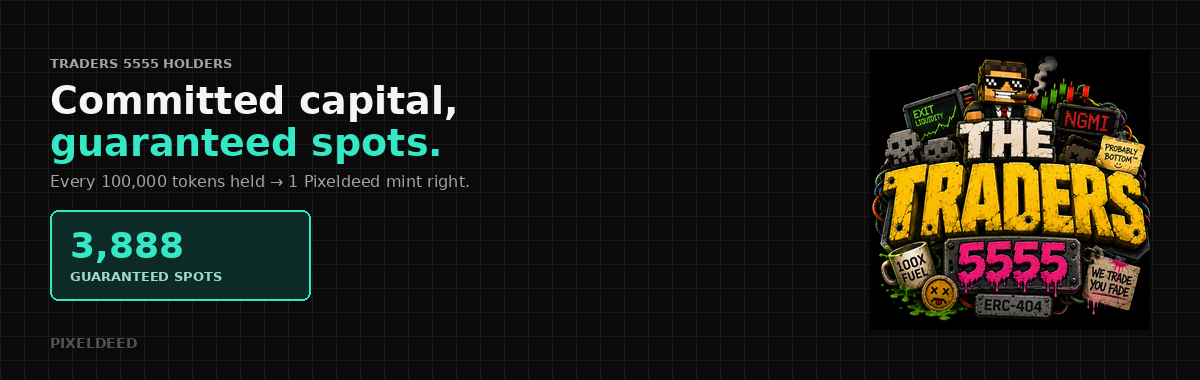
This track produced 3,888 spots. A snapshot has already been taken and the associated LP tokens have been burned ("more utility coming soon on Traders 5555"). This isn't about the most active users - it's a separate mechanism to reward the users who committed the most capital to the ecosystem's core collection.
6. KOLs and other active addresses
Beyond this, KOLs and other addresses who have actively contributed to the community were also allocated separate guaranteed spots. This is meant to combine the purely onchain-data-driven methodology with real community engagement.
7. Whitelist 2 (FCFS) - who's automatically included
Guaranteed Whitelist is only awarded to users with an effective collection count of ≥3, but Whitelist 2 (FCFS) casts a much wider net:
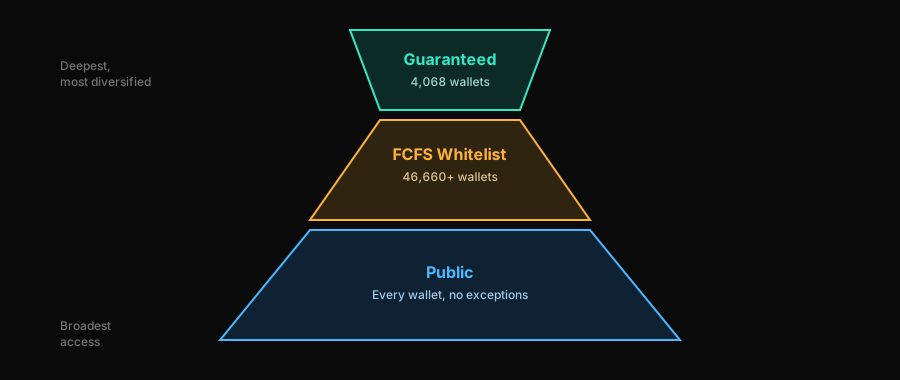
- All 46,660 wallets across the 47 Robinhood Chain projects - regardless of whether they received a Guaranteed spot, these wallets are automatically placed into Whitelist 2 (FCFS) and can mint on a first-come, first-served basis once the mint window opens.
- Azuki, DeGods, One Gravity, Yapybaras - all holders of these four large collections outside of Robinhood Chain are likewise placed directly into Whitelist 2 (FCFS). These collections weren't part of the diversity analysis, so they weren't counted toward Guaranteed spots - instead, they were automatically added to FCFS to bring the wider ecosystem closer.
In other words: the Guaranteed Whitelist is a reward for the deepest, most diversified users, while Whitelist 2 (FCFS) is a broad-access opportunity for Robinhood Chain's active NFT community, as well as holders of well-known, reputable collections from across the broader blockchain space.
8. The four-phase mint structure
Pixeldeed NFTs mint in 4 phases in total - each phase only begins once the previous one has finished:
| Phase | Name | Description |
|---|---|---|
| Phase 0 | Treasury | Team allocation, mints first |
| Phase 1 | Whitelist 1 - Guaranteed | Diversity analysis + Traders 5555 holders + KOLs - guaranteed eligibility |
| Phase 2 | Whitelist 2 - FCFS | The 46,660 wallets across 47 Robinhood Chain projects + Azuki/DeGods/One Gravity/Yapybaras holders - first come, first served |
| Phase 3 | Public | Opens to everyone once all whitelist phases have concluded |
9. How the total supply breaks down
Pixeldeed's total max supply is 10,000 NFTs:
| Category | Amount |
|---|---|
| Team Allocation | 1,000 (10%) |
| Diversity Guaranteed Whitelist | 4,068 wallets (1-6 Cells each, depending on tier) |
| Traders 5555 Holders (token-based) | 3,888 spots |
| Whitelist 2 (FCFS) reach | 46,660 wallets (47 projects) + Azuki/DeGods/One Gravity/Yapybaras holders |
Worth being clear on: Guaranteed Whitelist is a guaranteed right (GTD) - not an obligation to mint. But in practice not everyone mints their full maximum, so it's normal (and expected) for the total eligible maximum to look like it exceeds the 10,000 supply - this is oversubscription by design. Whatever a user doesn't use of their allocation rolls over into the next phase, FCFS and Public.
Conclusion: A system that rewards real users, not bots
Pixeldeed's whitelist methodology comes down to one principle: how deep, how long, and across how many fronts you were actively involved on Robinhood Chain. Not Discord invites, not "gm" counts - only real, verifiable onchain activity counts.
- Diversity - users active across many collections are rewarded more
- Conviction - users who committed large amounts of token/NFT capital are rewarded through a separate track
- Community - KOLs and active addresses are specifically recognized
- Broad reach - 46,660 wallets from Robinhood Chain, plus holders of well-known collections like Azuki, DeGods, One Gravity, and Yapybaras, all get FCFS access and can compete for the mint window
This isn't just about who showed up first - it's a system built to measure who is genuinely building, and continuing to build, the ecosystem.
Buy the pixel. Own the deed. Earn the whitelist.
Checker is live - pixeldeed.xyz/checker
See exactly which phase you qualify for and how many Cells you're eligible to mint.