August 27, 2026
The Philosophy of Go: Why Claiming the Right Territory Early Matters for Pixeldeed
What is Go, and why is "territory" everything?
In chess, you win as long as your king survives. In the game of Go, the outcome is decided by one thing alone - how many points of territory did you secure? Black and white stones are placed alternately on a 19x19 grid, and whoever controls more territory by the end wins.
What's striking is that in Go, not every stone is worth the same. Where you place a stone matters far more than the fact that you placed one at all. This is exactly the same dynamic at play in Pixeldeed - every one of the 1,000,000 pixels may look identical, but their strategic value is anything but equal.
This single insight from Go offers Pixeldeed users five principles that translate directly.
1. Corner → Side → Center: Early positions are cheaper and easier to defend
A foundational rule in Go is start in the corners, then the sides, and only later move toward the center. A corner only needs two walls to seal off territory, so a handful of stones can secure a large area. The center, by contrast, is exposed on all four sides - defending the same amount of territory there requires far more stones.
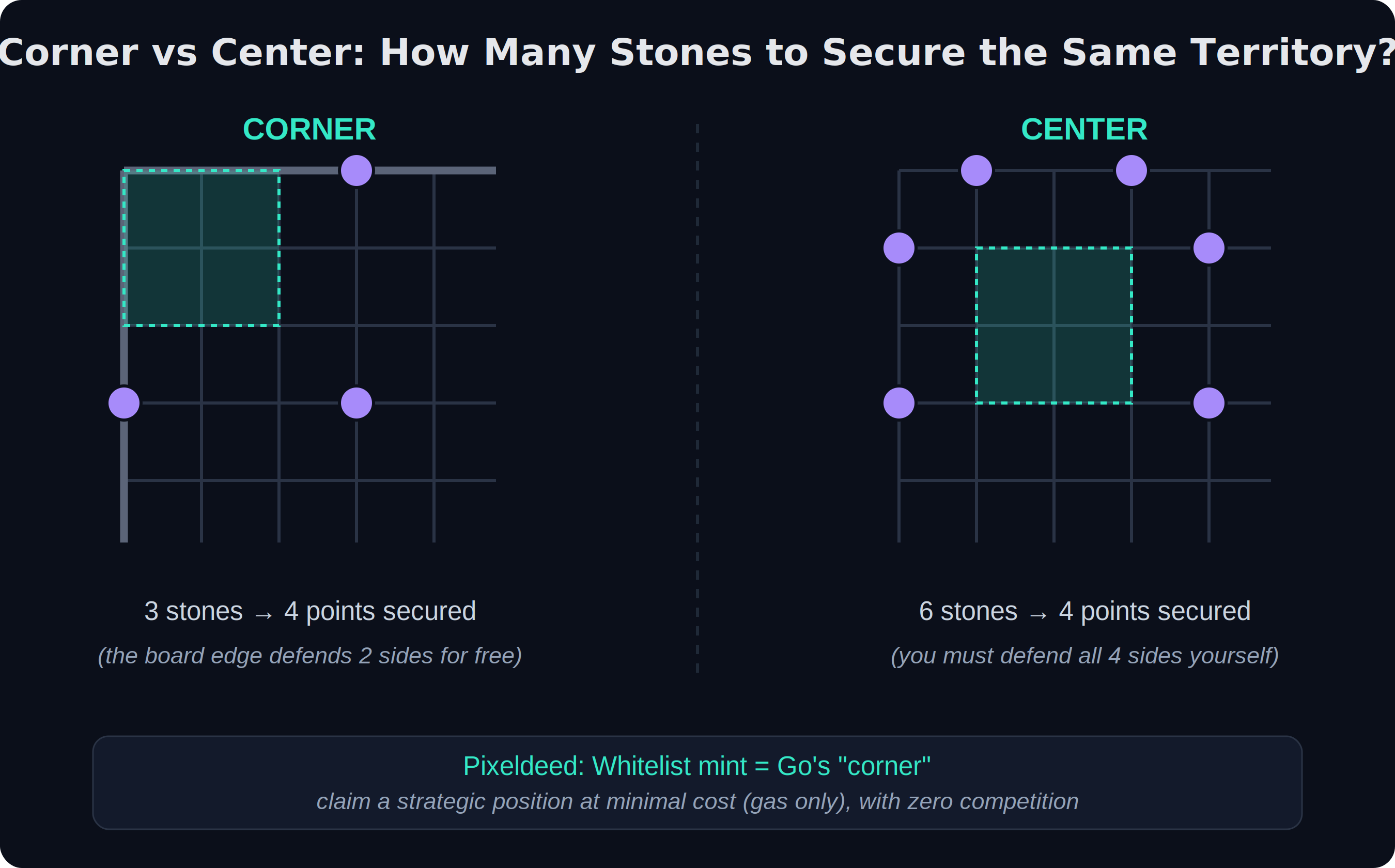
The exact same principle plays out on Pixeldeed.
The whitelist mint window is like the "opening moves" of the game - at this stage, there's no competition, and you can claim a strategic position on the grid at the lowest possible cost (gas only). The public mint and the resale market that follow are like Go's "midgame and center fight" - both the price and the competition for any given Block rise sharply.
2. A lone stone is weak; a connected group is strong
One of Go's core concepts is that a connected group of stones is far more likely to survive than isolated, scattered stones. A connected group shares more "liberties" (open adjacent points), so it can't be wiped out from a single attack.
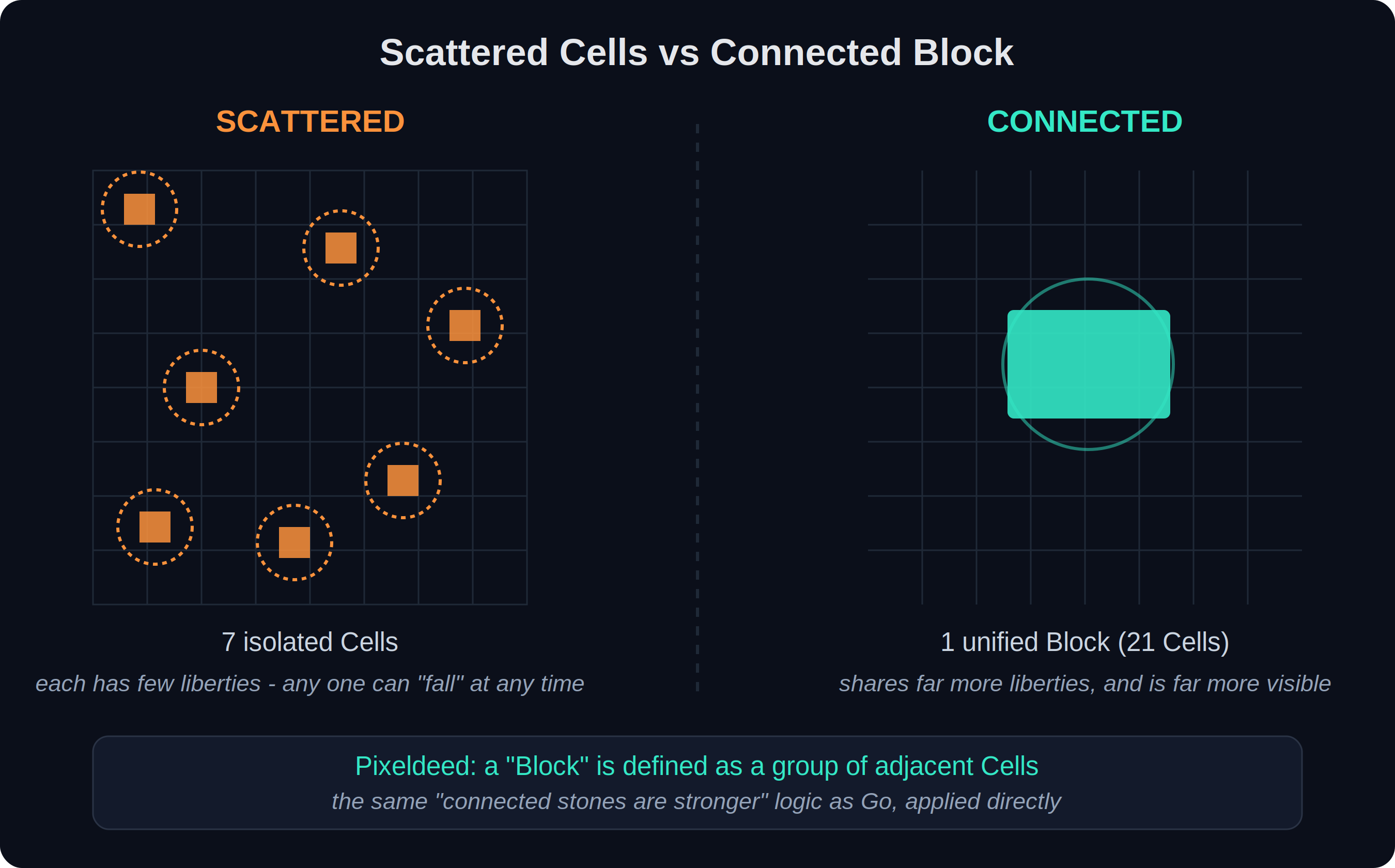
This maps almost word-for-word onto Pixeldeed's own definition of a Block: "Groups of adjacent Cells" is, quite literally, Go's connectivity logic. Buying scattered, isolated Cells is like placing lone stones in Go - visibility, brand impact, and future resale value all suffer.
By contrast, deliberately combining adjacent Cells into one large, bold Block gives you:
- A larger, more visible ad surface (visibility scales up, just as a group's "eyes" grow in Go)
- A higher resale price later (a single, large, solid territory is always worth more than a fragmented patchwork of small ones)
- An edge for rental income (big brands and businesses look for one large, prominent placement)
3. Sente and gote - Who controls the tempo
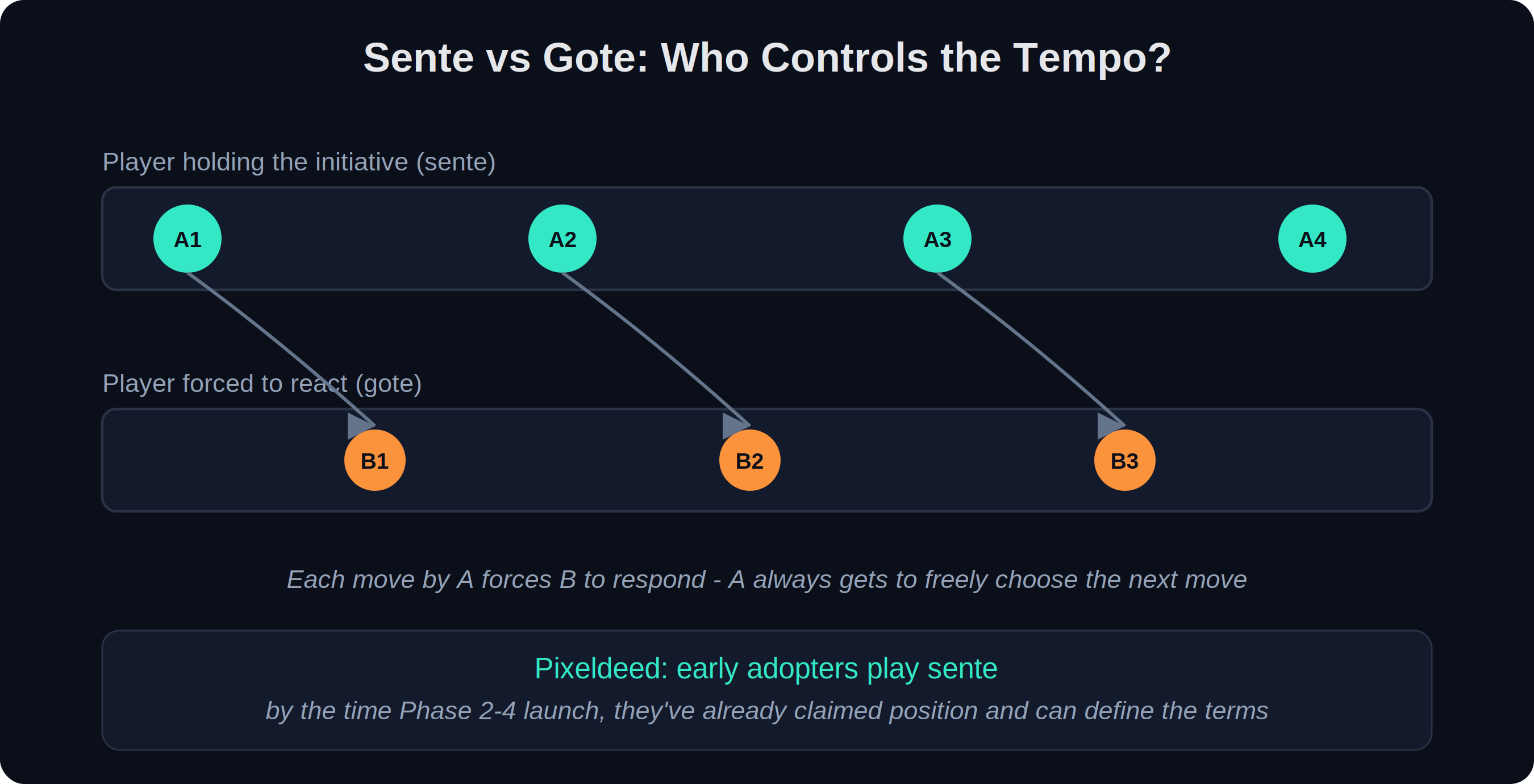
In Go, a player whose move compels a local response from the opponent is said to have sente (先手, "preceding move") - the initiative. The player forced to respond plays gote (後手, "succeeding move"). One side attacks in sente; the other defends in gote. A player who can keep sente controls the flow of the entire game, so gote is usually only accepted to defend a weak spot or lock in a specific local gain. In the endgame, strong players race to play every remaining sente move first, and only then settle for the largest available gote move - a reverse sente play is a gote move made specifically to deny the opponent a sente opportunity.
There's also a related, more aggressive option: tenuki - deliberately ignoring an opponent's forcing (sente) move and playing elsewhere instead. It's a calculated gambit: you accept a small local loss in exchange for grabbing a bigger opportunity somewhere else on the board.
Pixeldeed users who enter early and settle into strategically important positions are playing sente. By the time Phase 2 features (Billboard, Homepage Takeover, Sponsored Search) go live, they'll already hold an advantageous position - they won't be picking from what's left, they'll be defining it. Latecomers end up playing gote - constantly reacting, choosing from whatever remains. And sometimes the tenuki instinct applies directly, too: it can be smarter to skip contesting a single contested Cell and instead claim a larger, undervalued cluster elsewhere on the grid - a small local "loss" traded for a much bigger strategic win.
4. Moyo - Planning tomorrow's territory today
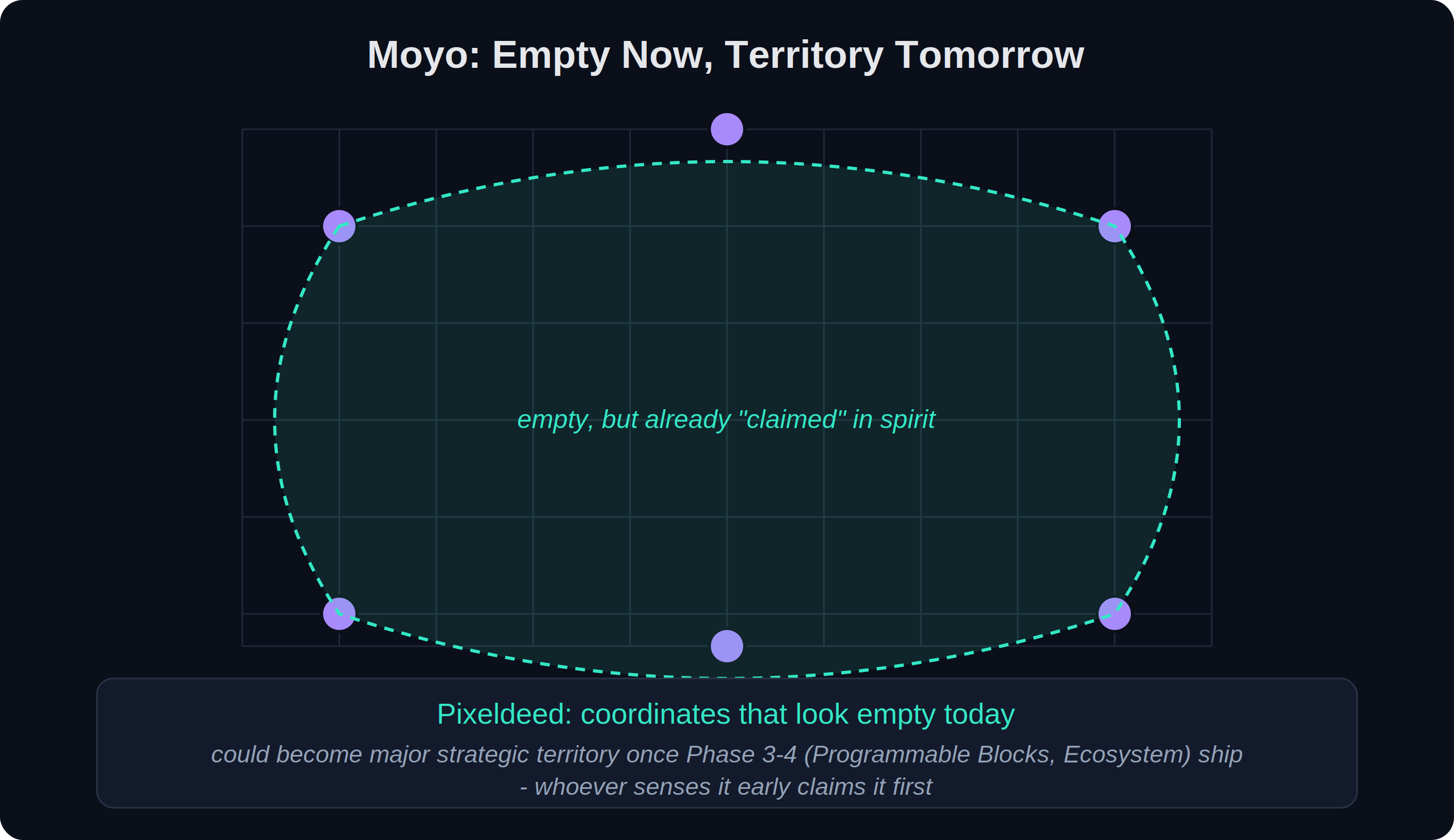
"Moyo" (模様, literally "pattern," often translated as "framework" or "potential") describes a loose framework for future territory, usually built from stones placed with gaps between them rather than a solid wall. The early game largely revolves around fighting over moyo - expanding your own framework while invading or reducing your opponent's. It isn't territory yet; it's a claim on territory that still has to be defended and closed off later.
The same principle applies to Pixeldeed's grid: areas that look empty today (for instance, spots near the center of the grid, or coordinates that major brands or communities might later seek out) could carry major strategic value once Phase 3-4 (Programmable Blocks, Ecosystem infrastructure) roll out. A handful of well-placed Blocks around an unclaimed area today is exactly the kind of loose framework that can be closed into solid territory tomorrow.
5. Aji - Value in unused potential
"Aji" (味, "taste") refers to the latent potential in a stone or a position to open up future lines of play - whether or not that potential is ever actually used. Aji affects the course of the game the moment it exists, simply by constraining what the opponent can safely do; "bad aji" is a weakness in your own position that the opponent might exploit at just the right moment. Reading when to cash in a piece of aji, or when to remove a threatening one from your own position, is one of the harder skills in Go.
Block ownership on Pixeldeed carries the same kind of latent value. The fact that a Block is non-custodial, sellable, and rentable is itself a form of aji - even a Block you're not actively displaying content on today still constrains the market (no one else can claim that spot) and keeps every future option - sell, rent, redesign - open for whenever conditions turn in your favor.
Conclusion: Not "the most pixels," but "the smartest pixels"
The deepest lesson Go teaches is that the strategic value of a position - not the raw size of the territory - decides the outcome. The same holds true on Pixeldeed: someone who buys 10,000 Cells isn't automatically "stronger" than someone who buys 100, if those 100 are grouped correctly, positioned well, and claimed at the right time.
Think of Pixeldeed as an online game of Go: the board is finite, early entrants get cheap positions, adjacent groups are inherently protected, and whoever holds the initiative defines the game's later phases. The value of online real estate, just like the physical world, still comes down to location, location, location.